


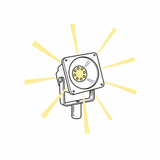
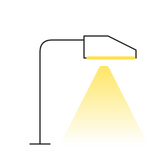
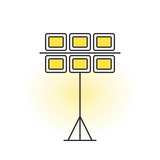

An LED stadium light is made for the largest outdoor spaces: sports fields, ports, loading docks, parking lots, and storage yards. At this power level, it is less about connecting it and more about the right location, the right angle, and the right lens. In this guide, I show you how to install, aim, and dim my stadium lights from 250W to 1500W, and how to change a lens.
How it works at a glance
- Choose the power and lens based on the height and the distance to the surface you want to illuminate.
- Mount the light on a pole, light mast, or facade using the bracket.
- Have it connected to 230V AC, optionally with a 1-10V dimming signal.
- Aim the light; combine multiple lights from different positions.
- Change the lens if necessary, always while the power is off, and check the seal.
⚡ Caution: 230 volts and height. These lights are heavy and hang high. Only work with a suitable aerial work platform and have the connection carried out by a certified installer. Always turn off the circuit breaker first.
The models at a glance
The lights are neutral white 5000K (the 500W is also available in warm white 3000K), IP66, with a die-cast aluminum housing. They operate from -20 °C to +50 °C, have a power factor of at least 0.95, and are dimmable via 1-10V. They last 50,000 hours, with a 5-year warranty.
Step by step
Determine location and height
Determine from which masts or facades you will illuminate the area. By combining multiple fixtures and mounting them in different positions, you get an even light distribution over the entire area, without dark corners and harsh shadows.
Mounting
The mounting bracket is suitable for poles, light masts, and direct attachment to a facade. Check whether the mast or facade can support the weight and wind load of the light.
Connecting
The light operates on 230V AC. If you want to dim it, the installer also connects the 1-10V dimming signal to a suitable 1-10V dimmer or lighting control. If you do not want to dim it, a switch or timer is sufficient.
Aiming
Aim the light at the surface you want to illuminate, not at residents or the road. When used in a port, never aim it at other ships.
Choosing and changing the lens
With a different lens, you change the beam. There is one lens per module on the light, so you need one lens per module. Always replace the lens with the power off and then check that the seal is properly seated again, so that the light remains watertight.
Which lens do you choose?
A narrow lens of 20° or 40° brings the light far away and concentrated on one spot, such as a field, a facade, or a mast at a great height. A wide lens of 60° or 90° distributes the light over a larger surface close by, such as a parking lot or a storage yard. The 1000W is also available as a narrow beam with 20° lenses; it has four lenses. How many modules your light has, you can see in the photos and in the specifications. The lenses can only be ordered together with a stadium light.
💡 Tip. With the 1-10V dimming signal, you adjust the light to the use: full light during a match or during loading and unloading, dimmed for security at night.
It does not work? Here is how you solve it
This guide is intended as advice; always follow the product manual if in doubt and have the connection to 230V carried out by a certified installer.
Frequently asked questions
Where do I mount an LED stadium light?
With the mounting bracket on a pole, light mast, or directly on a facade.
Can I dim an LED stadium light?
Yes, the lights are dimmable via a 1-10V dimming signal.
How many lenses do I need?
One lens per module of the light. How many modules your light has, you can see in the photos and in the specifications.
Which lens do I choose?
A lens of 20° or 40° for light far away and concentrated, 60° or 90° for a large surface close by.
How big is a 1000W stadium light?
630 × 240 × 590 mm, with 170,000 lumens.
A lighting plan for your area?
You can find all the powers and lenses in my LED stadium lights. For a sports field or business area, I am happy to make a proposal; send me the dimensions and mast heights via the contact form.
Bas van LEDPLANET.NL