


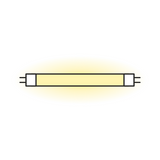

An LED fluorescent tube replaces your old fluorescent tube one-to-one in the existing luminaire. You save a lot on electricity, the light no longer flickers and you no longer have starters or tubes that keep breaking. In this guide I show you how to install my LED fluorescent tubes: the standard T8 and T5 tubes and the T8 tubes with a built-in motion sensor. If you want to know which ballast you have first, the step-by-step guide in the knowledge base explains this in detail.
How it works at a glance
- Measure the old tube and choose the same length and type (T8 or T5).
- Check which ballast is in the luminaire.
- Conventional: replace the starter with an LED starter and screw in the tube.
- Electronic (and always with T5): remove the ballast and connect the tube directly to 230V~.
- Turn the circuit back on and test.
⚡ Caution, 230 volts. Always turn off the circuit in the fuse box before opening the luminaire. If in doubt, have the conversion, such as removing a ballast, done by an electrician.
Which tube fits your luminaire?
An LED fluorescent tube has exactly the same length as the fluorescent tube it replaces. Measure the old tube, or look at the wattage printed on it, and find it in the table.
The length is measured without the pins; with pins, a tube is approximately 14 mm longer. You can tell T8 and T5 by their thickness: a T8 tube is clearly thicker than a T5 tube, and the fittings differ. A T8 tube will therefore never fit in a T5 luminaire or vice versa.
My tubes are made of aluminium with a polycarbonate cover instead of glass, so nothing can shatter if one falls. They are IP20: intended for dry indoor spaces. For a wet or dusty space, you are better off choosing a waterproof LED fluorescent luminaire.
Step by step
Power off and remove the old tube
Turn off the circuit in the fuse box. Turn the old tube a quarter turn until the pins are in the slot of the fitting and remove it. An old fluorescent tube contains mercury: return it to the recycling centre or a collection point, not with the general waste.
Check which ballast is inside
Remove the cover plate from the luminaire. If you see a starter (a small round cap in a fitting) and a heavy block, you have a conventional ballast. If there is no starter and a flat, light box, it is electronic. T5 luminaires always work with an electronic ballast.
Conventional? Replace the starter
Turn out the old starter and replace it with an LED starter. The ballast can then remain in place. Some of my tubes already come with the LED starter; this is stated in the product description. Then screw the LED tube into the fittings.
Electronic or T5? Connect directly
The electronic ballast must be removed. Then connect the tube directly to 230V~. My tubes are single-ended: the power comes in on one side, phase and neutral on the same side. The fitting on the other side receives no voltage and only holds the tube.
Test
Turn the circuit back on. The tube should light up immediately and without flickering. If it does not light up, turn off the power again and look at the troubleshooting table below.
The T8 tube with motion sensor
Some of my T8 tubes have a motion sensor in the end cap: a microwave sensor that detects motion at a distance of 4 to 6 metres, measured at a mounting height of 3 metres. After the last movement, the tube turns off automatically; there are versions with 30 and 60 seconds. You install the tube in exactly the same way as a regular tube.
💡 Tip. If you hang multiple sensor tubes close together, keep at least 1.5 metres between the sensors. Otherwise, they will see each other and keep turning each other on.
Good to know: the sensor looks through plastic, glass and thin non-metallic materials, but not through metal. A luminaire with a metal grille or cover under the tube can therefore block the sensor. The sensor does not have a daylight sensor, so the tube also switches on during the day. Read more about sensors in LED lighting with a motion sensor.
Does it not light up? Here is how you solve it
This guide is intended as advice; always follow the product manual if in doubt and have it connected to 230V by a certified electrician.
Frequently asked questions
Does an LED fluorescent tube fit in my existing luminaire?
Yes, if the length and type (T8 or T5) are the same as the old tube. A T8 tube has a G13 connection, a T5 tube has a G5 connection.
Does the ballast need to be removed?
Not with a conventional ballast: you only replace the starter with an LED starter. An electronic ballast must be removed; this is always the case with T5 luminaires.
What does single-ended connection mean?
The power comes in on one side of the tube: phase and neutral are on the same side. The other fitting only holds the tube.
Can an LED fluorescent tube be used in a damp space?
My LED fluorescent tubes are IP20 and intended for dry indoor spaces. For damp and dusty spaces, choose a waterproof IP65 luminaire.
How far does the sensor of the sensor tube see?
4 to 6 metres, measured at a mounting height of 3 metres. Keep at least 1.5 metres between two sensor tubes.
Tubes needed for a whole room?
You will find all lengths and light colours in my LED fluorescent tubes, also per box. If you are not sure what you need, send me a photo of your luminaire via the contact form.
Bas van LEDPLANET.NL