


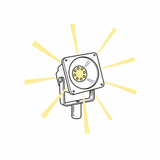
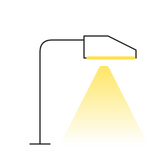
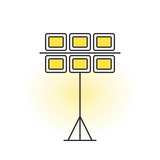

With an LED street lamp, you can illuminate a private road, a driveway, a parking lot, or the path along a business premises. My street lamps have an asymmetrical street lighting design: the light shines across the road, not into the sky or your neighbours' gardens. This guide shows you how to mount, connect, and aim them on a pole or against a facade, and how far apart to place the poles.
How it works at a glance
- Choose the power based on the pole height and road width.
- Choose the set with a pole adapter or a wall adapter.
- Slide the lamp with the adapter onto the Ø60 mm pole or arm and set the angle.
- Connect the lamp to 230V, optionally via a timer or switch.
- Testing: the daylight sensor version turns on automatically at dusk.
⚡ Caution: 230 volts and working at height. Only work at height using suitable lifting equipment or scaffolding, and have a certified installer connect it to the 230V supply. Always switch off the circuit first.
Which power is right for your road?
All lamps have a die-cast aluminium housing with optical glass, operate from -20 °C to +50 °C, and last 50,000 hours, with a 5-year warranty. The lens distributes the light asymmetrically over 140° × 70°: wide in the direction of the road and narrower to the sides. This allows you to illuminate a longer stretch of road with fewer poles.
On a pole or against a wall
The lamps fit on a light pole or arm with a diameter of Ø60 mm. Most sets include an adapter. With the pole adapter, you place the lamp on a pole and set the angle from 0 to 90°. With the wall adapter, you mount the lamp directly to a facade or wall without a light pole. Please note: one 30W version is designed for a Ø40 mm pole; this is stated in the title.
Step by step
Plan the poles
Leave approximately three to four times the pole height between the poles for even lighting. For 6-metre poles, this means about 18 to 24 metres.
Mount the adapter and lamp
Slide the lamp with the pole adapter onto the Ø60 mm pole or arm, or attach the wall adapter to the facade. Tighten the mounting securely.
Set the angle
Adjust the pole adapter so that the lamp illuminates the road surface and not the adjacent facades or gardens. The wide side of the beam should be along the road.
Connect
Connect the lamp to 230V. The version without a sensor stays on as long as it is powered: combine it with a timer, a central lighting control system, or a switch. The version with a daylight sensor switches automatically.
Test
The lamp with a daylight sensor turns on at dusk (16 lux) and off in daylight (25 lux). If you want to test it during the day, briefly cover the sensor. Test the lamp without a sensor using the switch or timer.
Not working? Here is how to fix it
This guide is intended as advice; if in doubt, always follow the product manual and have a certified installer connect it to the 230V supply.
Frequently asked questions
What pole diameter are the LED street lamps suitable for?
For a light pole or arm with a diameter of Ø60 mm; one 30W version is designed for Ø40 mm.
How far apart should I place the poles?
Approximately three to four times the pole height, for even lighting.
When does the daylight sensor turn on?
At dusk, at 16 lux, and off again in daylight, at 25 lux.
Can I hang the street lamp on a wall?
Yes, with the wall adapter you can mount it directly to a facade or wall without a light pole.
Which power do I need?
For a pole height of 6 to 8 metres, use 60W, 100W or 150W; for pole heights of 10 to 13 metres and roads 12 to 15 metres wide, use the 200W.
Illuminating an entire area?
You will find all power options, also per box, in my LED street lighting. For a plan with the number of poles, I am happy to help you calculate it via the contact form.
Bas van LEDPLANET.NL