



You see LED everywhere: in bulbs, TVs, car headlights and flashlights. But what does LED actually mean, how does such a tiny component produce light and why is it so much more economical than an incandescent bulb? In this guide I explain it in plain language.
In short
- Meaning: LED stands for Light Emitting Diode, a small semiconductor that gives off light when current passes through it.
- Economical: an LED uses about 85 to 90% less power than an incandescent bulb.
- Long-lasting: good LED bulbs often last 15,000 to 50,000 burning hours.
- Choosing: look at lumens, light color and dimmability, not at watts.
Jump straight to:
What does LED mean?
LED is short for Light Emitting Diode. A diode is a semiconductor that only lets current pass in one direction. In an LED, light is released in the process. So an LED is not a filament in a glass bulb, but a tiny chip of less than a millimeter.
How does an LED work?
Light from a semiconductor
The chip contains two layers of semiconductor. When current flows through, electrons collide with holes in the other layer and the energy is released as light. Nothing has to glow, so far less energy is wasted as heat than with an incandescent bulb.
How do you get white light?
Most white LEDs are actually blue LEDs with a layer of phosphor. That layer converts part of the blue light into yellow and red, and together the eye sees that as white. With a different phosphor you make warmer or cooler white, see LED color temperature.
Driver and cooling
An LED runs on low-voltage direct current. That's why every LED bulb contains a driver that converts the 230 volt mains voltage. The LED itself does get warm at the chip, which is why cooling (a heatsink) is important for a long lifespan. You'll find terms like driver and heatsink in the LED alphabet.
Pros and cons of LED
Advantages
LED is economical, long-lasting, gives instant light and contains no mercury. You can dim LED, buy it in many colors and make it in almost any shape. What you save with it you can read in LED vs incandescent, halogen and CFL.
Disadvantages
The purchase price is higher than an incandescent bulb, although you earn that back. Cheap LEDs can flicker or lose color, and not every LED is dimmable. See Dimmable LED bulbs and dimmers.
Types of LED lighting
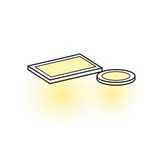
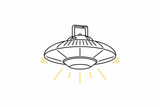
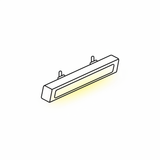
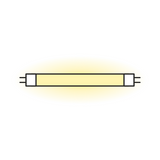
You'll find LED in bulbs (E27, E14), spotlights (GU10), TL tubes, panels, strips, floodlights and flashlights. Take a look at the LED spotlights, LED strips, LED tubes and LED panels.
What to look for when choosing
Look at lumens for brightness, Kelvin for light color and the fitting. See What is lumen? and Choosing LED lighting.
📩 More LED tips in your inbox?
Sign up and you'll get a 5% welcome discount in your inbox right away. After that I'll send you a new LED tip now and then. You can unsubscribe at any time.
Frequently asked questions
What does LED mean?
How long does an LED bulb last?
Does an LED bulb get warm?
Is LED better than an incandescent bulb?
Why do some LED bulbs fail quickly?
Kind regards,
Bas / LEDPLANET.NL