



Good professional LED lighting makes for safe and pleasant working and often pays for itself within a few years in commercial spaces. But which fixture goes where? In this guide you read, for each space, from industrial hall and warehouse to office, workshop, car park and sports field, which LED lighting fits, how much light you need and what you save with it.
In short
- Hall and warehouse: LED high bay, from 4 to 5 metres in height.
- Workshop and garage: linear or tri-proof fixture. Office: LED panel 60x60.
- Outdoors: floodlight for facade and yard, street light for driveway and site, stadium light for sports fields.
- Savings: a 150 watt LED high bay saves about 187 euros per year per fixture compared with a 400 watt metal halide.
Jump straight to:
Which lighting where?
| Space | Guideline value | Best choice |
|---|---|---|
| Industrial hall, shed, warehouse (from 4 to 5 m) | 150 to 300 lux | LED high bay |
| Workshop, production, garage (up to approx. 4 m) | 300 to 500 lux | Linear or tri-proof fixture |
| Office, practice, classroom | 500 lux | LED panel 60x60 or 30x120 |
| Car park, corridor, stairwell | 75 to 150 lux | Tri-proof with sensor |
| Facade, yard, loading and unloading area | 20 to 50 lux | LED floodlight |
| Driveway, car park, company road | 10 to 20 lux | LED street lighting |
| Sports field, riding arena, large site | 75 to 200 lux (training) | LED stadium light |
The lux values are common guideline values. For workplaces, the values from the European standard for workplace lighting apply in practice, and for large projects a lighting plan is wise. You can read what lux and lumen are in What is a lumen?.
Industrial hall, shed and warehouse: LED high bays
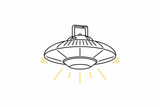
In spaces with a high ceiling, the light from ordinary fixtures barely reaches the floor. High bays are made for that: round, powerful fixtures (also called UFO lights because of their shape) that direct the light downwards in a focused beam. They replace the old metal halide and sodium lamps, which use much more power and have to warm up for minutes.
| Mounting height | Power per fixture (indication) | Spacing between fixtures |
|---|---|---|
| 4 to 6 metres | 60 to 100 W | approx. 4 to 6 metres |
| 6 to 8 metres | 100 to 150 W | approx. 6 to 8 metres |
| 8 to 12 metres | 150 to 200 W | approx. 8 to 10 metres |
Rule of thumb: a spacing roughly equal to the mounting height keeps the light even. Use a narrow beam (60 degrees) for high racking and a wide beam (90 to 120 degrees) in open halls.
What should you look for?
Lumens per watt: the higher, the more efficient. Modern high bays reach 140 lumens per watt or more. Adjustable power: handy if you do not yet know exactly how much light you need. Sensor and dimmable: in warehouses where work is not continuous everywhere, this saves a lot of power. IP65: dust-tight and protected against water jets, also suitable for dusty or unheated halls.
Examples from my range
The LED high bay 100W with motion sensor (15,000 lumens, dimmable) and the LED high bay 150W with adjustable power (set of 4). See all LED high bays.
Workshop, garage, car park and corridor
LED linear fixture
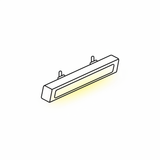
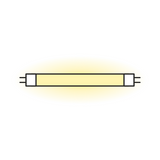
For ceilings up to about 4 metres, long fixtures are the best choice: a wide, even beam over workbenches, machines and walkways. The LED linear fixture replaces the classic fluorescent batten as a complete fixture. See LED tube lighting. If you still have old fluorescent battens, first read Replacing fluorescent tubes with LED.
Tri-proof fixture
Dust-tight, waterproof and impact-resistant (usually IP65 and IK08). Ideal for workshops, car washes, stables, cold stores and unheated spaces. See the tri-proof fixtures, such as the tri-proof fixture 120 cm, 4480 lumens, IP65. How many fixtures you need is covered in LED lighting for the workshop, and which IP rating suits in IP rating explained.
Fixtures with sensor
In a car park, corridor or stairwell, lighting often burns unnecessarily all day. A tri-proof fixture with a microwave sensor (radar) detects movement, even through thin materials, and switches the light on, off or to a low level. An example is the tri-proof fixture 150 cm with microwave sensor (6250 lumens). You can read about the difference between sensors in LED lamp with sensor.
Office, practice and school: LED panels 60x60
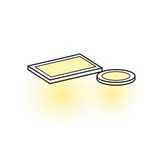
In offices with a suspended ceiling, the LED panel 60x60 is the standard. It fits directly into a ceiling tile of 60 by 60 cm and gives soft, even light without harsh points of light. For an office workstation, 500 lux on the desk is the guideline value.
What do you look for in an LED panel?
UGR (glare): the lower, the less glare. UGR below 22 is fine for general spaces; for long periods of screen work, UGR below 19 is recommended. Light colour: 4000K is the most used in offices, see LED colour temperature. Colour rendering: Ra 80 or higher for offices, Ra 90 for practices and shops. Size: 60x60 (595x595 mm) for standard suspended ceilings, 30x120 or 30x60 for rectangular tiles.
Examples
The efficient LED panel 60x60 of 28W with 4200 lumens (8 pieces), or an LED panel 60x60 with adjustable light colour and RGB for waiting rooms and shops, for example. See the LED panels and downlights and the office lighting. Working from home? Read Desk lighting for working from home.
Facade, yard, driveway, car park and sports field
LED floodlights
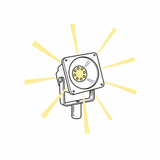
For facades, yards, loading and unloading areas and storage sites (also called wide-beam lights or work lights). Choose IP65 or IP66, a beam angle of 120 degrees for wide surfaces nearby and 90 or 60 degrees to light further away. A sensor makes sure the light only comes on when someone approaches, see the outdoor lighting with sensor. Aim it down at an angle so you do not dazzle neighbours and road users. A powerful example is the LED floodlight 100W with 15,000 lumens (IP66). See the LED floodlights for outdoors and read Installing outdoor lighting.
LED street lighting
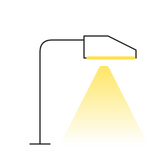
For a car park, driveway or road on your own site, an LED street light on a pole is the neat solution: wide, flat light without light spill upwards. With a daylight sensor it switches on by itself at dusk. Pole height 4 to 6 metres: about 60 to 100 watts per fixture. Pole height 6 to 8 metres: about 100 to 150 watts. Spacing: about 3 to 4 times the pole height. See the LED street lighting 60W with daylight sensor (9000 lumens) or the whole collection from 30 to 200 watts.
LED stadium lights
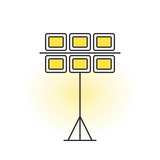
For sports fields, riding arenas, tennis courts and large storage sites: very powerful floodlights of 250 to 1500 watts. For training, 75 to 200 lux is usual, for matches more. Because the light distribution is so important, I always recommend a lighting plan for sports fields. Example: the LED stadium light 500W with 85,000 lumens (IP66). See all LED stadium lights.
Hospitality, holiday parks and rentals
If you manage many light points, buying one by one is impractical. Dimmable filament lamps are also available in boxes of 10, such as the dimmable LED filament lamp E27, box of 10. See also the LED filament lamps and LED value packs.
What do you save with professional LED lighting?
In commercial spaces, lamps burn many hours, so the savings add up quickly. A worked example for a hall:
| Metal halide 400 W | LED high bay 150 W | |
|---|---|---|
| Burning hours per year | 2500 | 2500 |
| Consumption per year | 1000 kWh (plus ballast losses) | 375 kWh |
| Cost per year (0.30 euros per kWh) | 300 euros | 112.50 euros |
| Saving per fixture | approx. 187 euros per year | |
With ten fixtures that is almost 1,900 euros per year, not yet counting the extra savings from sensors and dimming. Use your own electricity price and burning hours for a precise calculation. For homes, a similar calculation is in LED vs. incandescent, halogen and CFL: what do you really save?.
Step-by-step plan for a professional lighting project
- Map out the spaces: dimensions, ceiling height, activities and conditions (dust, moisture, cold).
- Determine the light level: use the table at the top as a guideline.
- Calculate the number of lumens: lux × m² divided by 0.6 gives a good first estimate.
- Choose the type of fixture: high bay, linear or tri-proof, panel, floodlight or street light.
- Choose light colour and IP rating: usually 4000 to 5000K, and IP65 in dusty, damp and outdoor spaces.
- Think about smart control: motion sensors, daylight sensors and dimming save extra.
- Have it connected by an installer: for fixed connection to 230V and for larger projects.
📩 More LED tips in your inbox?
Sign up and you get 5% welcome discount in your inbox right away. After that I will send you a new LED tip now and then. You can unsubscribe at any time.
Frequently asked questions
What is a high bay?
How many lux does a warehouse need?
Does an LED panel 60x60 fit every suspended ceiling?
What is the difference between a linear fixture and a tri-proof fixture?
Which light colour do you use in an industrial hall?
Can I replace existing fixtures with LED without new cabling?
Kind regards,
Bas / LEDPLANET.NL